In which I attempt to showcase that Indian traffic is a case of many Prisoner’s Dilemmas occurring at once.
Background
As I sat in the passenger seat while my dad drove in Indian traffic, my head spun. Indian traffic, for the uninitiated, is pulsating, pumping, a ride full of instantaneous switches, turns, and noises. Did I mention it is nauseating?
After spending hours in the passenger seat and clutching my seat, I began to wonder why this happens. The obvious answers like a lack of law enforcement and other systemic facts jump out. I even asked my relatives and they said the same thing. But these are societal and institutional issues. I started to wonder if there is a more behavioral way for why this happens.
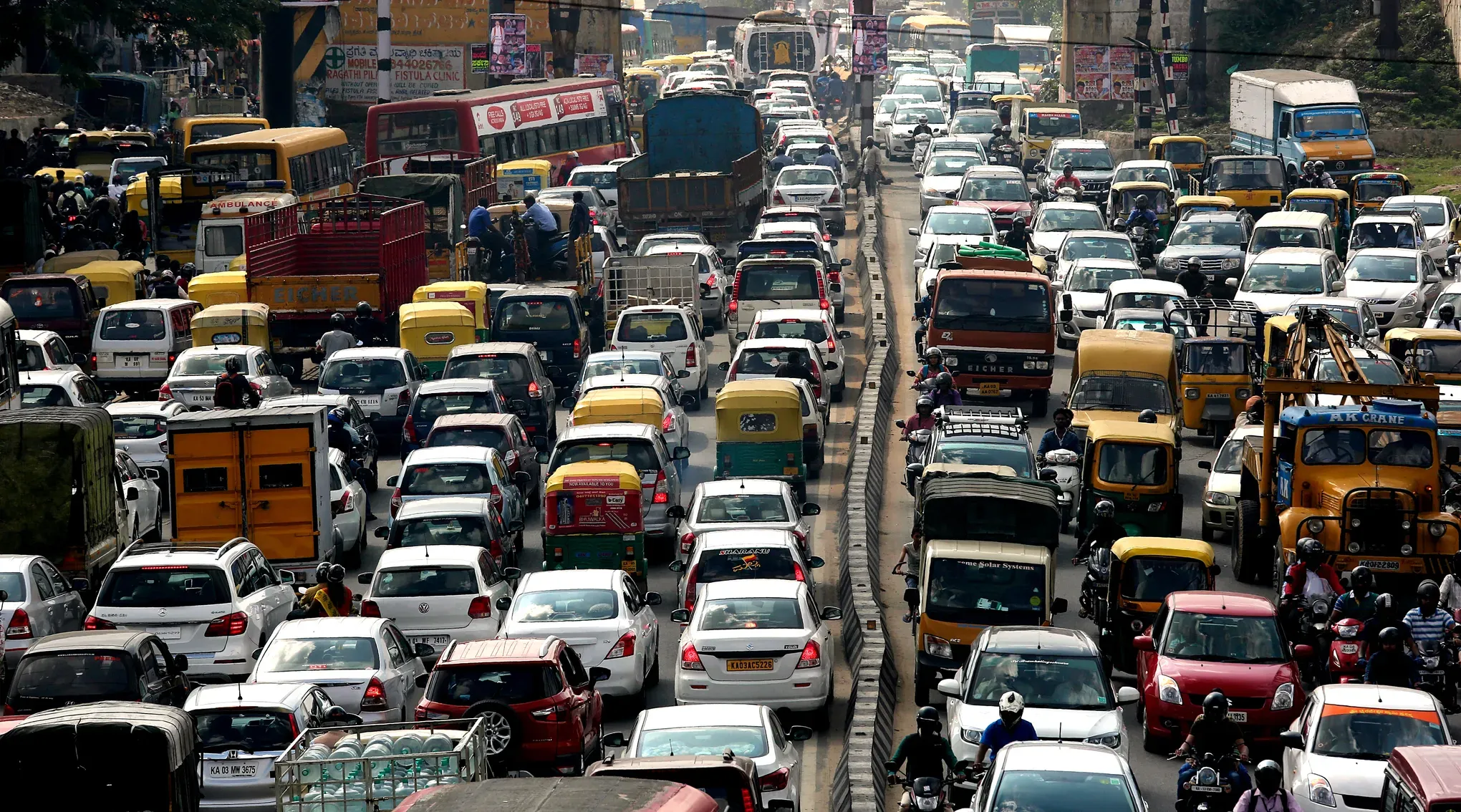
Last semester, I studied Game Theory which attempts to inform how we should and would behave in certain games. I decided to see if I could apply Game Theory principles to Indian traffic. After much thought, I landed a rough draft of why Indian traffic can be seen as Prisoner’s Dilemmas occurring at scale.
Note: This isn’t a rigorous proof nor is it trying to be. This was literally written while the car stopped and I had to find a way to kill the time. I decided to make those scribbles into a proper blog because I think my reasoning is cool. I wrote this when I had little internet access. Searching this on Google, I found that other people had thought the same! And that was cool.
Hope you enjoy!
1) Defining Prisoner’s Dilemma
Two suspects are placed in separate rooms with a wall between them — no communication allowed. They have been caught in a theft.
The police interrogate each separately and present the following deal:
- If Jann and Bob both plead guilty (cooperate), they each receive a reduced sentence.
- If one defects — betrays the other — the defector goes free while the other receives maximum time.
- If both defect, both receive a heavy sentence, though not the maximum.
These payoffs can be structured as a matrix:
| Bob: Cooperate | Bob: Defect | |
|---|---|---|
| Jann: Cooperate | −3, −3 | −10, 0 |
| Jann: Defect | 0, −10 | −5, −5 |
defect = plead not guilty | cooperate = plead guilty
Values shown as: Jann’s outcome, Bob’s outcome (years in prison)
Game Theory tells us the DOMINANT STRATEGY for either player is to always defect.
Here is why. From Jann’s perspective:
- If Bob cooperates, Jann gets 0 years by defecting vs. −3 years by cooperating. Defect wins.
- If Bob defects, Jann gets −5 years by defecting vs. −10 years by cooperating. Defect wins.
Defection is the dominant strategy regardless of what the other player does. The same logic applies symmetrically to Bob. The tragedy is that mutual defection (−5, −5) is worse for both than mutual cooperation (−3, −3) — yet rational self-interest pushes both players away from the cooperative outcome.
Here’s another graphic to really instill the concept:
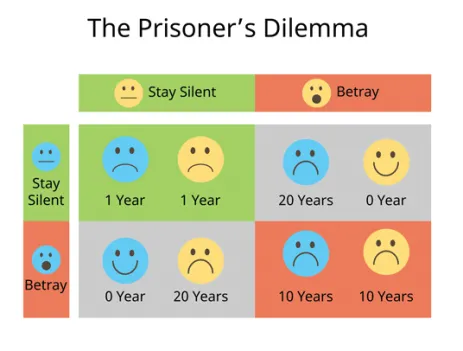
Insight: Long-term rewards and credible punishment can shift behaviour — but only when there is a shared desired future and a mechanism to enforce consequences.
2) Why Indian Traffic Resembles Prisoner’s Dilemma
Consider two drivers — Anil and Shreya — approaching the same intersection.
Framing the encounter as a Prisoner’s Dilemma requires us to examine whether conditions for cooperation are present.
1) Is there a shared future reward?
Anil and Shreya are strangers travelling in different directions. They will almost certainly never encounter each other again. There is no ongoing relationship, no reputation at stake between them specifically, and no repeated game dynamic. The future reward that would incentivise mutual cooperation — “I’ll yield today so you yield next time” — simply does not apply here.
2) Why is the threat of an accident not sufficient to enforce cooperation?
One might argue that safety is a shared future reward — both drivers prefer not to crash. This is true in principle. But in practice, the probability of a collision at a slow-moving urban intersection feels low to each driver. Safety works as a deterrent at high speeds but not at 10 km/h in a congested crossing.
3) Is there a credible threat of punishment?
Traffic enforcement in dense Indian urban environments is sparse and inconsistent. Police presence is low relative to the number of intersections. Traffic cameras are present in some corridors but far from universal. The probability of a fine for any single act of cutting a queue or jumping a signal is low enough that it does not constitute a reliable deterrent — particularly when the gain (saving 30–60 seconds) is immediate and the punishment is probabilistic and delayed.
4) The payoff matrix for two drivers
With the above conditions, let’s try to define a payoff matrix just liek before
Let us define:
- Cooperate (C): yield, wait your turn, allow the other driver to pass first
- Defect (D): push forward, cut in, refuse to yield
| Shreya: C | Shreya: D | |
|---|---|---|
| Anil: C | −2, −2 | −3, −1 |
| Anil: D | −1, −3 | −5, −5 |
Values represent units of time (the number of seconds) lost.
Mutual defection (−5, −5) produces gridlock — the intersection seizes up and both lose significantly more time than if either had simply yielded.
As in the classical Prisoner’s Dilemma, defection is the dominant strategy for each individual even though mutual cooperation produces a better collective outcome.
3) Scaling Up: The Whole Road is Many Simultaneous Prisoner’s Dilemmas
The two-driver case is illustrative but simplified. A real urban road is not one Prisoner’s Dilemma — it is hundreds occurring in parallel, in sequence, and in cascade.
Each cell in the animation above represents an independent PD encounter. The key property is that the outcomes of adjacent PDs interact: when Drivers A and B deadlock in PD #1, they block the approach lanes for PD #2 and PD #3. One defection cascades into forced defection for others who had no intent to defect — they simply have nowhere to go.
This has a structural consequence: the incentive to defect increases as surrounding defections increase. If every driver around you is pushing forward aggressively, cooperating (waiting) means you may never move at all. Rational response to a defecting environment is to defect yourself. The system locks into a Nash Equilibrium of mutual defection — and it is self-reinforcing.
At scale, the dominant strategy shifts even more decisively toward defection.
4) What Would Change the Equilibrium?
The classical solution to repeated Prisoner’s Dilemmas is discounted future rewards + threat of punishment.
Three interventions could plausibly shift Indian traffic toward cooperation:
Consistent enforcement. If the probability of a fine for signal-jumping or queue-cutting were high enough and the fine large enough, the expected cost of defection would exceed the expected gain. This requires both camera infrastructure and consistent follow-through — neither of which is trivially achievable at scale.
Reputation mechanisms. In small, closed communities — apartment complexes, specific market lanes, regular commute corridors — drivers do encounter each other repeatedly. Anecdotally, traffic in these micro-environments tends to be more cooperative. The shadow of the future is present. Extending this to open roads is structurally difficult.
Infrastructure that removes the choice. Roundabouts, dedicated turn lanes, and signal timing that physically prevents simultaneous conflicting movement eliminate the PD by removing the option to defect.
5) Caveat
This is a simplified model. Several factors are not captured:
- Driver skill and experience vary enormously; an experienced driver can often navigate a conflict with minimal loss to both parties
- Stress, time pressure, and cognitive load shift individual payoff calculations in ways a static matrix cannot represent
I’m not saying that every Indian driver is making a calculated game-theoretic decision.